


Skinive’s accuracy report “Dynamics of the neural network accuracy in the context of modernization of the algorithms of skin pathology recognition” is officially published at Social Science Research Network.

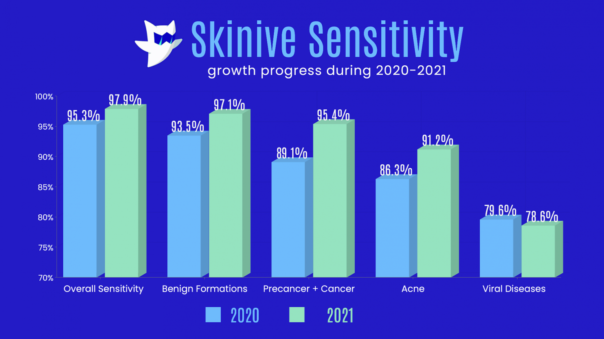
Skinive neural network uses a machine-learning algorithm to calculate the risk rating of skin pathologies. For this study, we used Skinive’s 2020 and 2021 versions trained on 64,000 and 115,000 images respectively. Three validation datasets were used to assess the sensitivity of the algorithm: precancer + cancer, HPV skin pathology, acne, containing 285 images in each set. The specificity has been calculated on a separate validation set containing 6,000 benign neoplasm cases.
The purpose of this study was to estimate the accuracy of Skinive’s algorithm.
We have improved the algorithm to show a statistically significant decrease in the number of neural network errors in determining the risks of skin pathologies.
The results of sensitivity and specificity of the Skinive neural network indicate that the algorithm is highly accurate in detecting various neoplasms and skin diseases. The sensitivity of the Skinive neural network in detecting malignant neoplasms was 89.1% and 95.4% in 2020 and 2021 respectively. The specificity of Skinive’s neural network in determining benign neoplasms was 95.3% in 2020 and 97.9% in 2021. For all skin neoplasms: in 2020, the sensitivity was 95.3%, for specificity 93.5%; in 2021, it was 97.9% and 97.1% respectively.
Download Full Report (PDF): https://papers.ssrn.com/sol3/papers.cfm?abstract_id=3974784
Recommended articles preview:

15th December 2018
The First Model With Vitiligo To Be Cast By Victoria’s Secret
Model Chantelle Brown-Young, who goes by the name Winnie Harlow, has walked the runways at New York Fashion Week (NYFW), appeared in ad campaigns, and promoted a message of self-love and body positivity through social media. But this year, the 24-year-old made history by becoming the first model with vitiligo to be cast by Victoria’s Secret. She’ll walk […]
10th December 2018
Iidentify your skin type online!
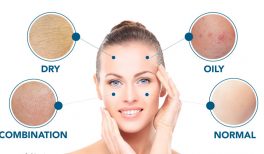
When determining skin type, two different conversations quickly surface. There is the more beauty-focused skin type discussion that refers to how our skin feels, how much oil it produces and how it reacts to products (think: normal, dry, oily, etc.) and then there is the skin type discussion that focuses on how our skin reacts […]

20th March 2020
Skinive at Rockstart AI Digital Demo Day.
For the past 6 months, we’ve been developing our business in ‘s-Hertogenbosch, the Netherlands, at the beautiful campus of the Jheronimus Academy of Data Science. We’ve been working hard and on March 19th we introduced Skinive to the audience of investors, corporates and program mentors at Rockstart AI Digital Demo Day! Due to the current […]